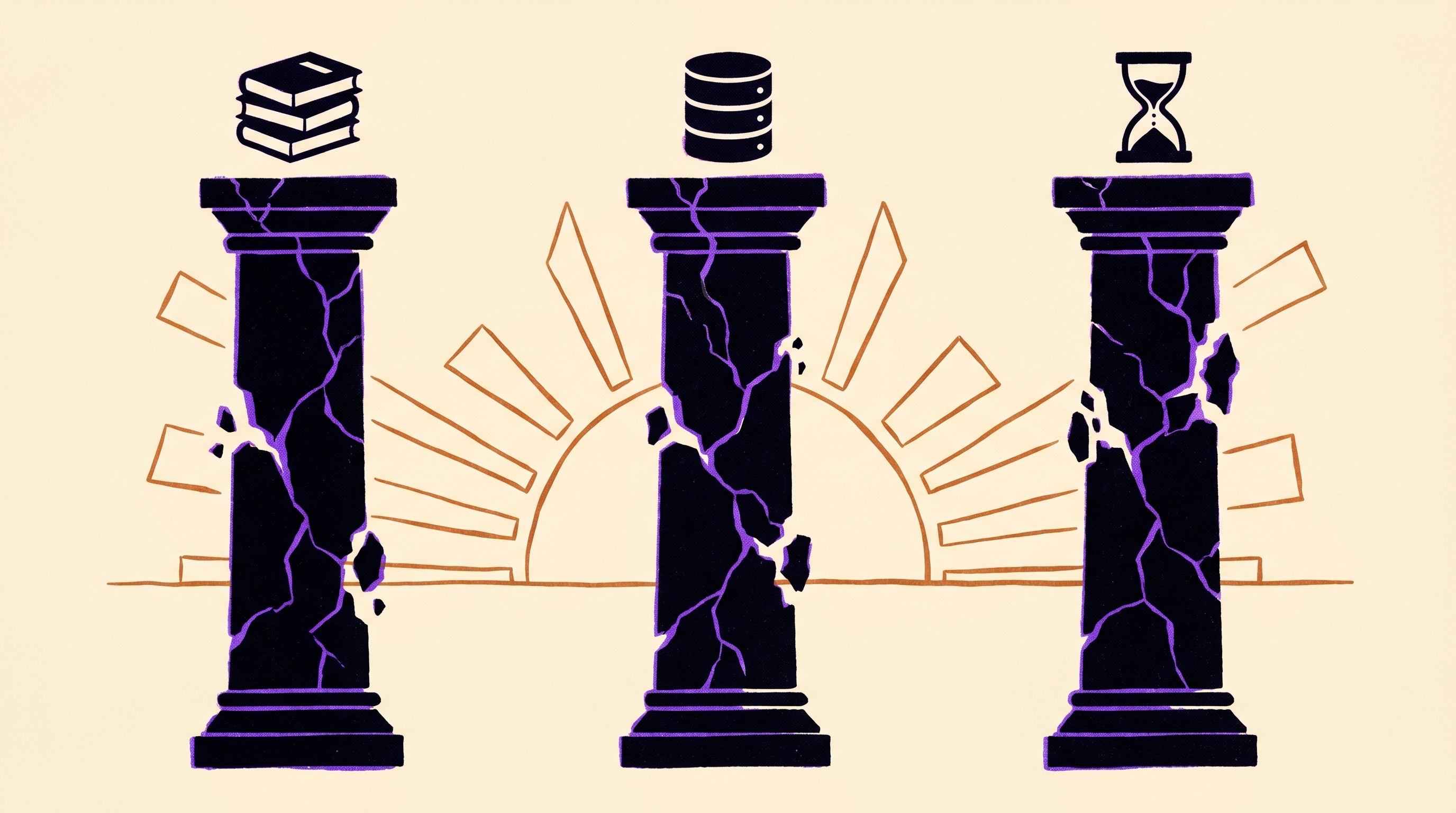
The conversation happens in every leadership team. Someone brings up AI. Someone else says the company isn't ready. A few heads nod. Nothing moves.
The myths about AI at work that keep teams stuck aren't obviously wrong. That's what makes them effective at stalling progress. They sound like caution. They feel like due diligence. But in practice they're just reasons to wait, and waiting has a real cost that rarely makes it onto a slide.
This isn't a post about why AI is exciting. It's about three specific arguments you've heard in your own organization, why each sounds reasonable, and why each is wrong.
Myth 1: do we really need to train everyone first?
This one is practically a boardroom reflex. Our people don't know how to use AI tools, so we can't adopt AI until they do. Training first, technology second.
It sounds responsible. Prioritizing people over tools. Nobody left behind.
The problem: training-first as a sequencing strategy almost never works.
Why training-first stalls
The companies that have successfully embedded AI didn't train and then deploy. They deployed, and training happened as a byproduct of using real tools on real work. The learning curve is much shorter when the tools are solving an actual problem the person has today.
The "train everyone first" model assumes AI adoption is primarily a skills problem. It isn't. Most of the repetitive, time-consuming work AI agents handle - pulling CRM data, routing support tickets, generating weekly reports, sending follow-up sequences - doesn't require the person doing that work to understand how the agent works. They just need to stop doing it manually.
A real comparison
A marketing ops team at a mid-size tech company spent six months scheduling AI literacy workshops before touching tooling. By the time training finished, the tools they'd been trained on had changed enough that half the training was outdated.
Meanwhile, their counterparts at a competitor started running agents in production on three repeatable tasks - content scheduling, lead enrichment, monthly reporting - and cut roughly 12 hours per week of manual work in the process.
The second team didn't attend a bootcamp. They described their routines in plain language, had an agent built around those routines, watched results come back. That's learning by doing, which is how most professional knowledge actually transfers.
What to do instead
Pick two or three routines that happen on a predictable schedule and involve repetitive decisions. Get an agent running on those routines while the rest of the team learns at whatever pace makes sense. Training can happen in parallel - it doesn't have to be the gate.
Myth 2: isn't our data too messy to start?
The most technically credible-sounding myth, which makes it the hardest to push back on in a room full of executives.
The argument: AI is only as good as your data. Our data is messy. Duplicates in the CRM. Spreadsheets aren't standardized. Different teams use different field names. We need to clean this up before doing anything meaningful with AI.
What's true and what's not
Two things are true. First, AI does work better with clean, structured data for certain applications. Second, "our data isn't ready" is almost always used to describe 100% of possible AI applications, when in reality it blocks 20-30% of them.
The work that doesn't need clean data
The vast majority of routine work AI agents handle doesn't require a clean data warehouse. They require the same data inputs the person doing the task manually already uses.
If your SDR manually opens LinkedIn, checks a company's latest news, writes a personalized email, and logs it in HubSpot - the data for that task isn't in your warehouse. It's live, on the web, in the tools you already use. An agent can do that exact task with no data cleanup required.
Same logic for internal workflows: summarizing meeting transcripts, routing inbound inquiries by content, generating status updates from project management tools, sending weekly digest emails from your own reports. None require clean historical data. They require the outputs your existing tools already produce.
Predictive vs. agentic AI
The data readiness myth conflates two different things:
- Predictive AI (forecasting, classification, scoring models): genuinely depends on clean training data.
- Agentic AI (takes actions based on current inputs): does not.
A demand forecasting model needs clean historical data. An agent that monitors your support queue and drafts responses to common questions does not. Most enterprise AI value sits in the second category.
What to do instead
Audit which routines actually depend on structured historical data versus which need only current inputs. Start with the latter. You'll likely find 60-70% of your highest-frequency manual tasks fall in the "doesn't need clean data" category. Start those immediately and tackle data infrastructure in parallel.
For a practical starting point, the hidden workflows guide surfaces work that could move to an agent this quarter.
Myth 3: shouldn't we wait for the tech to mature?
This one has a long track record in technology adoption cycles. Sometimes it's actually good advice. If you're evaluating a genuinely experimental technology with high implementation risk and low switching cost, waiting makes sense. Watch others fail, learn from their mistakes, adopt when the category stabilizes.
The problem: the "wait for it to mature" window for AI agents on routine business tasks has already closed. Not because the technology is perfect - it isn't - but because the cost of waiting now exceeds the cost of the imperfections you'd be waiting to fix.
The compounding pattern
McKinsey State of AI 2025: companies that adopted AI 12+ months before survey reported meaningfully higher productivity gains than companies that adopted in the past six months. Time in production matters as much as which tools you pick. Early adopters aren't just getting tool value - they're building internal knowledge about where AI works and doesn't, which is itself a competitive asset.
The Stanford AI Index 2026 found the gap between AI leaders and laggards in the same industry increased for the third consecutive year. The companies waiting aren't closing the gap. They're extending it.
The hidden cost of waiting
Beyond foregone productivity: every week a team member spends two hours pulling the same report is two hours they could spend on judgment work. Every month your sales team manually researches accounts is time that doesn't come back. The "wait" isn't free. It's a recurring subscription to your current inefficiency.
Moving goalposts
The mature-technology argument moves over time:
- 2023: "wait for the models to improve"
- 2024: "wait for the integrations to stabilize"
- 2026: "wait for agentic reliability to improve"
At some point the pattern becomes visible: there will always be a next version. Waiting for it is a choice to keep paying the current cost indefinitely.
What to do instead
Accept the technology will keep improving and adopt anyway. The right frame isn't "is this perfect?" but "is this reliable enough to replace this specific manual task in production?" For a large class of repetitive, rules-based routines, the answer is yes today.
The AI adoption gap piece goes deeper on what's actually driving the wait-and-see pattern - worth reading if this myth has come up in your own leadership conversations.
What do all three myths have in common?
All three position adoption as something that comes after preparation. After training. After data cleanup. After the tech matures. The implicit model: get ready, then go.
That model is how you adopt a new ERP. It's not how you adopt AI agents.
AI agents are narrow and modular by nature. You're not implementing a platform that touches every process at once. You're picking one routine, building one agent, running it, learning, moving to the next. The failure mode is low-cost and reversible. The preparation costs in the myths above are often higher than the cost of just starting.
The pattern that cuts through all three: pick a bounded, repetitive task, get an agent running on it this week, let the evidence from production shape your next decision. You'll learn more from one agent in production than from six months of strategy.
That's the core of Uplift. You describe a routine in plain language. The team scopes it, builds the agent, runs it 24/7, maintains it as things change. You don't need to train your staff first, clean your data first, or wait for better infrastructure. You just need to find the routine eating the most time - and stop doing it manually.
If the three myths sound familiar, the for-your-team page is a practical place to start mapping which routines are good candidates.
Frequently asked questions
Isn't training-first the safer approach?
It feels safer because it delays risk. In practice it locks in higher cost (manual work continues) and creates training that goes stale before tools deploy. Safer is: deploy one bounded agent with reversible scope, let people learn from it, expand from there.
What if our data IS the bottleneck for what we want to do?
Then your AI plan should start with the agents that don't need clean data (routing, summarization, drafting, monitoring) while data work runs in parallel. You'll capture 60-70% of value without waiting. The data-dependent applications come online once the warehouse work catches up.
How do I know if we're a 'leader' or 'laggard' in our industry?
Count routines running on agents in production right now. Zero or one = laggard. Five+ across multiple functions = leader. The Routine Coverage Ratio (covered in our AI literacy KPI article) is the cleanest version of this measurement.
What's a good first agent for a team that's never deployed one?
Pick the highest-frequency, lowest-judgment routine you can name. Common starting points: weekly status reports, inbound lead enrichment, ticket categorization, meeting summary distribution. Anything that runs every week or more, follows predictable logic, and doesn't decide where money moves.
How do we explain this to a board that's heard all three myths from their consultants?
Show them the cost of waiting in dollars (see our hidden-cost article). Show them the year-over-year widening gap (Stanford AI Index). Show them one production agent running and the hours it returned. Boards respond to numbers and demos, not to arguments against caution.