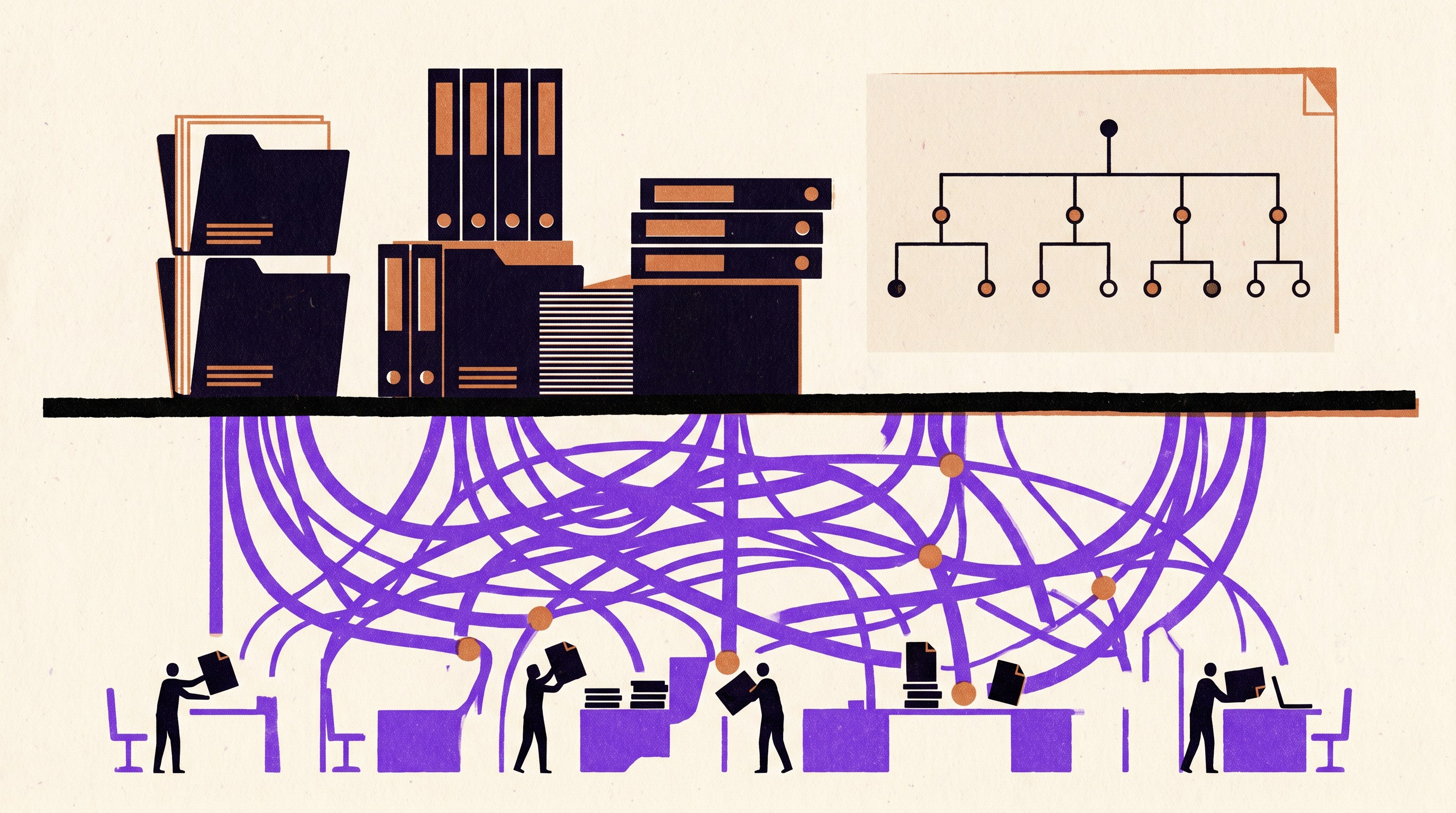
There's a version of your company that exists on paper. The org chart. The Notion wikis nobody reads. The processes documented during onboarding.
And then there's the version that actually runs.
It's a parallel system of routines nobody mapped, nobody owns, and nobody wants to admit takes up most of the day. Your best SDR copying data between Apollo and HubSpot at 9pm. Your HR coordinator reformatting CVs because the inbound ones come in five different formats. Your IT manager answering the same five ticket types on repeat.
This isn't a productivity problem. It's a systems problem. Most companies don't know how big it is because nobody's measured it. The number, when you do measure, is uncomfortable.
Why do hidden workflows stay hidden?
Hidden workflows survive because they live below a threshold. They're too small to ticket. Too repetitive to celebrate. Too granular to surface in a quarterly business review.
Nobody says "I spent four hours this week formatting resumes" in a team meeting. It sounds petty, and there's no obvious fix. So the work continues - quietly, invisibly, and at scale.
The below-the-API-line problem
The tools your company uses have integrations, webhooks, and API documentation. Salesforce talks to HubSpot. HubSpot talks to Slack. The mapped paths are clean.
The workflows that live between those tools - in the white space of human coordination - don't have any of that. They exist in someone's muscle memory and a chain of browser tabs.
Call it the below-the-API-line problem. Leadership sees throughput at the top: deals closed, tickets resolved, reports submitted. The cost - 30 to 60 percent of the working week disappearing into routines that were never meant to become permanent - sits underneath, invisible.
Why nobody fixes them
Three reasons hidden workflows persist:
- The person doing the work doesn't have authority to change the system
- The person with authority doesn't know the work exists
- The technical team doesn't have context for either of them
That triangle is the entire problem in one sentence. Until someone breaks it, the work continues.
How do you find the routines nobody mapped?
The fastest way to find hidden workflows is to ask one question: what did you do this morning before 10am?
Not "what are your responsibilities." Not "what tools do you use." Those questions produce job descriptions. The 10am question produces the actual work.
What you'll hear, if you ask honestly: "I checked if yesterday's leads came in from the campaign, moved the ones that converted to the deal stage in HubSpot, sent a quick Slack to the AE, updated the sheet we use to track demos, and then I had a 9am."
That's four workflows in eleven minutes. None of them are in any onboarding document.
Step 1: Map the transfers
For every task someone describes, ask: where does the information start, and where does it need to end up?
A hidden workflow almost always involves moving data between systems. The gap is where the human is. Map it - source system, target system, the manual translation step in the middle. That's the workflow.
Step 2: Count the repetitions
Once a week? Every day? Three times a day during close? Repetition is the signal.
The more often a task repeats, the more it costs. And the higher the return from not doing it manually. Daily tasks compound faster than monthly ones. Weekly reporting routines compound faster than quarterly reviews. Start where the frequency is highest.
Step 3: Ask what breaks it
Every hidden workflow has a failure mode. The lead that fell through because someone forgot to check the sheet. The invoice that went unpaid because the notification landed in the wrong inbox. The candidate who took another offer because the recruiter was in back-to-back meetings.
The failure mode is the business case for doing something about it. If a workflow has no failure mode - if nothing bad happens when it doesn't run - you don't actually need to automate it. Skip it.
What does manual work actually cost?
The numbers are worse than most leaders realize. Specifically, on the sales side, Spotio's 2024 productivity research and the Bridge Group's SDR benchmarks consistently show that SDRs spend roughly 60% of their working week on tasks that aren't selling.
Think about what that means structurally. You're paying for sales capacity and receiving less than half of it. The rest is going into hidden workflows.
The math for a 5-person sales team
Fully loaded SDR cost (salary + benefits + overhead): roughly $80,000 per person. Bridge Group's 41% admin figure applied to that:
- Per-person admin cost: 0.41 × $80,000 = $32,800/year
- 5-person team: $164,000/year
That's the cost of low AI adoption in your sales function alone, expressed as wages paid for work that agents should be running. The same math, with different multipliers, runs across HR, IT, finance, and ops.
What scales with headcount
The 41% figure holds across team sizes - meaning the cost scales linearly. Ten SDRs? $328,000. Fifteen SDRs? $492,000. Every new hire inherits the same admin burden.
This is why "we'll get to it later" is the most expensive line in the conversation. The cost doesn't sit still while you get to it - it runs every two weeks on payroll.
Five hidden workflows by function
Every function has its own version. The pattern is consistent: high-frequency repetitive work, performed by a skilled person, producing no judgment-based output. Here's what to look for in each.
Sales: the SDR research loop
What it looks like: every morning, SDRs pull overnight leads, check LinkedIn, cross-reference the CRM, look up company size and industry, add notes, build sequences.
The cost: 45 minutes to 2 hours before the first call. For an 8-person team, that's 300 person-hours per month spent on work that doesn't require judgment - just consistency.
The hidden secondary cost: leads scored quickly while everyone's still caffeinating. Promising accounts that don't make it to the sequence because the researcher ran out of time.
HR: the CV formatting grind
What it looks like: applications arrive in different formats from LinkedIn, careers pages, direct email, referrals. Someone has to make them comparable before a hiring manager will look.
The cost: 30-60 minutes per open role per week, in pure translation work. No insight added. No judgment exercised.
Adjacent workflow: preliminary screening against a job description. If you have 80 applications and your hiring criteria are written down, a human is not the most efficient first-pass filter. But most HR teams are doing it anyway because the alternative was never set up.
Marketing ops: the monthly reporting ceremony
What it looks like: export from the ads platform. Export from HubSpot. Match by date. Calculate blended CPL. Format the table. Wait for someone to ask why the numbers don't match last month's slide. Re-export. Re-send.
The cost: 3-6 hours per month per analyst. Not because the data is complicated, but because it lives in three systems and has to be stitched together by hand every time.
IT: the ticket triage problem
What it looks like: a help desk queue full of password resets, access requests, software installs, "where do I find X" questions. The IT manager reads each one, categorizes it, routes it to the right person.
The cost: HDI's Service Desk benchmarks show 30-40% of tickets are Level 1 issues. For a 5-person IT team, that's $105K-$180K per year in cost allocated to ticket types a configured agent could handle.
The downstream cost: when IT spends 35% of the day on Level 1 work, there's 35% less capacity for what actually moves the organization - security infrastructure, system migrations, vendor evaluations.
Finance: the close-cycle reconciliation sprint
What it looks like: the night before close. Pull actuals from the system. Compare to expected values in a spreadsheet. Find the gaps. Chase the gaps. Re-pull. Reconcile again.
The cost: 5-8 days per month on close, with 40-60% of that time on data wrangling rather than analysis (per Gartner finance benchmarks). For a 4-person finance team, $128K/year in wages going to work that follows fixed rules.
The opportunity cost compounds: variance analysis, scenario modeling, cash flow forecasting - the work CFOs actually need - keeps getting deferred.
How do you start automating hidden workflows?
The mistake most teams make is starting with the obvious. They automate the sales report or the onboarding email sequence - the things that are already documented, already ticketed, already expensive enough to have someone's attention.
That's not wrong. It's just incomplete.
Start with the routines, not the projects
The real return is in the workflows nobody thought to automate because nobody thought to look. The SDR research loop. The CV screening pass. The monthly report assembly. The ticket triage queue. The reconciliation sprint.
These aren't edge cases. They're the company. They're just invisible until someone asks the right question.
The 30-minute conversation that surfaces them
Run a 30-minute session with each function head. Three questions:
- What did you do this morning before 10am?
- What would break if you were out for a week?
- What part of the week would you eliminate if you could?
You'll get answers. Some will be about meetings. But a meaningful fraction will be about routines - specific, repeatable, invisible routines that have been running quietly for months or years.
That's your list.
The hand-off question
Once you have the list, the question is who builds the system that runs the routines.
Training people to do them faster is not the answer. Building automation that runs them is. The challenge is that the team running the routines doesn't usually have the technical resources to build the automation, and the technical team doesn't usually have the operational context to scope it right.
Uplift is built around exactly that gap. You describe a routine in a 30-minute conversation. We scope it, build it, run it, and keep it running as APIs and models change. The maintenance burden - the part that turns "we built something cool" into "we have a problem" - doesn't fall on your team. That's the point.
For a function-by-function breakdown of what can be automated and what it costs, explore the team pages. For the broader case on why this matters now, read about the AI adoption gap.
Frequently asked questions
What's the difference between a hidden workflow and a documented process?
A documented process appears in your wiki, onboarding docs, or SOPs. A hidden workflow is the actual sequence of steps someone takes to do their work - including the parts that aren't in any document. Hidden workflows are often what people actually do; documented processes are what we tell new hires they do.
Why can't we just hire more people to handle the manual work?
Because the math doesn't work. Every new hire inherits the same 41% admin burden. You're scaling the cost, not solving the problem. Adding headcount also adds onboarding time, management overhead, and tooling cost. Automating the routines once removes the burden permanently across the team.
How long does it take to automate a hidden workflow?
It depends on the complexity, but most well-scoped routines (lead enrichment, report generation, ticket triage) can be running in production within 2-3 weeks. That includes scoping the workflow, building the agent, testing against real data, and deploying. Ongoing maintenance is then continuous, not project-based.
What if our team is too busy to map all our hidden workflows?
Start with one function and one hour. The 30-minute conversation usually surfaces enough to get started. You don't need a complete inventory before you act on the first one. Pick the most expensive routine you can identify in one meeting, automate that, then move to the next.
Will employees feel threatened if we automate their hidden workflows?
Usually the opposite. People who spend 40% of their day on manual admin know the work is beneath their skill level. Automating it frees them for the work they were hired to do. Resentment shows up when management ignores the burden, not when leadership solves it.