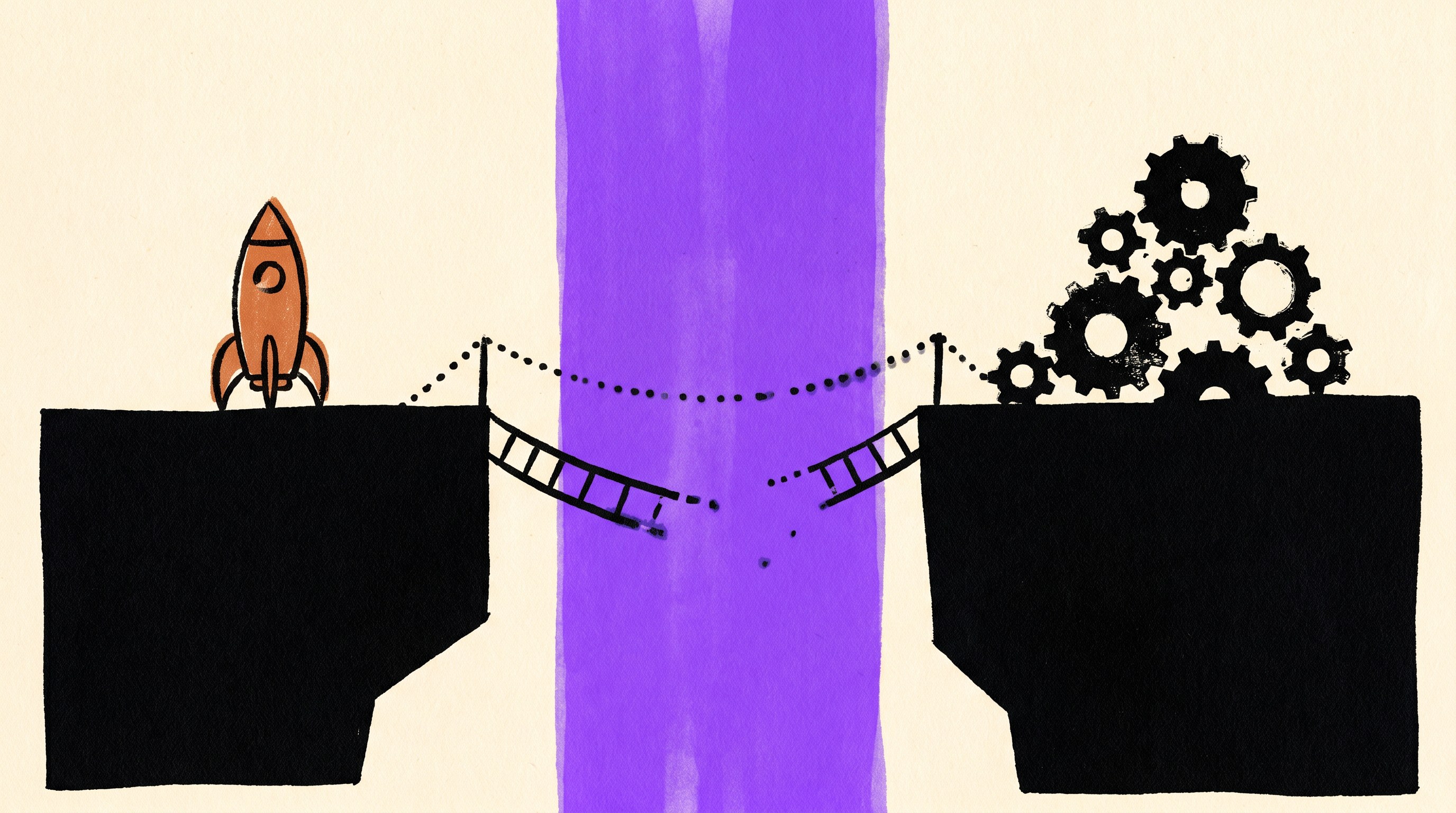
The AI adoption gap is not what most people think it is.
It is not a technology problem. The tools exist. It is not an awareness problem - McKinsey's State of AI 2025 found that 88% of knowledge workers now use generative AI in some capacity. It is not even a literacy problem. Most people who spend a week with a good language model figure out how to ask it useful questions.
The gap is between using AI to think with and building systems that use AI to work for you. Those are not the same thing, and the distance between them is where 91% of AI pilots die.
Why do most AI pilots stay as pilots?
The path from pilot to production has four distinct failure points. Each is solvable in isolation. Together they form a wall most organizations quietly walk away from rather than climb.
Integration debt accumulates faster than demos suggest
A pilot runs in a controlled environment. The AI tool gets clean inputs, a single system to read from, and a narrow task. The demo looks good because the demo is not the real workflow.
The real workflow involves six tools. Three have outdated documentation. One uses a deprecated API version that works fine until it doesn't. The authentication setup requires coordination with IT, which means a ticket, which means two weeks, which means the business stakeholder who was excited in the demo has moved on.
Integration debt is not a technical edge case. It's the default state of any company with a 5+ year SaaS stack. The AI tool has to plug into reality, not a sandbox.
Maintenance burden is never scoped into the project
When an AI system goes live, the work doesn't stop. It changes.
Prompts drift. A language model updates and last month's reliable output is subtly different this month - not broken, just wrong in ways that don't trigger alerts. The CRM API changes. The business rule encoded in step three no longer reflects how the team actually works.
None of this is captured in a project scope. Pilots get build resources. They rarely get ongoing maintenance budget because admitting the system needs ongoing maintenance sounds like admitting it's fragile, and nobody wants that in an ROI deck.
The result: systems that worked in Q1 quietly degrade through Q2 and Q3. By Q4, someone is doing the task manually again "just until we fix it."
No production pipeline means no handoff
The technical team builds the pilot. Whose job is it to run in production?
In most organizations this question has no clean answer. Engineering treats it as project completion, not ongoing service. The business team lacks technical context to monitor it. IT owns infrastructure but not logic. The original AI champion has been assigned to the next initiative.
There's a reason most companies have multiple dashboards showing AI usage metrics and very few showing AI business outcomes. Usage is what tools report. Outcomes require someone watching the pipeline end-to-end - which requires permanent ownership.
Model drift and prompt rot are slow, silent, underestimated
Language model behavior is not constant. Models change between versions. Context windows get longer, changing how the model weights early versus late information in a prompt. An AI system tuned on GPT-4o in late 2025 may behave differently by mid-2026 - not catastrophically, but enough to degrade accuracy in ways that don't surface until a human notices the output is wrong.
This is prompt rot. The system was designed for a model version that no longer exactly exists. Nobody budgeted for the quarterly re-tuning required to keep production systems at baseline accuracy.
Not glamorous work. But it's the work. And it's almost never scoped.
What does the gap actually look like in numbers?
Think about what that gap means structurally. You're spending on AI capacity and getting fractional return. The work that should have shifted to agents is still happening manually because the production pathway never closed.
The math for a 200-person company
Three pilots per year, average $80K build cost, 91% never reach production: roughly $220K/year in non-recoverable AI investment. That's not the deepest cost.
The deepest cost is opportunity. The hours that should have shifted to higher-value work are still being burned on the routines the pilot was supposed to absorb. That's where the $400K-$800K range in hidden cost across functions comes from.
A pilot that should have scaled
A mid-size fintech - 180 employees, ops-mature, capable VP of Operations - ran an inbound lead routing pilot in Q3 2024. The AI classified leads by size and use case, routed to the right SDR sequence.
The pilot worked. Eight weeks in: routing accuracy above 90%, response time dropped from 11 hours to under 20 minutes, the SDR team had noticeably better first-touch context. VP presented to C-suite. Everyone pleased.
By Q1 2025 the system was off. CRM migrated to a new HubSpot version. Form fields changed. A new product tier was added that the routing logic didn't know about. The engineer who built it was on a different project. The VP spent three weeks trying to get it back on the roadmap and eventually stopped.
This is not unusual. The gap was not in the pilot. It was in everything that came after.
Why doesn't more training or better dashboards close the gap?
When companies recognize the AI adoption gap, they usually respond with one of three interventions. None closes the gap.
More training
AI literacy programs address the individual layer. They help people get better at prompting, evaluating outputs, working alongside AI tools. They do not build systems that run without humans. Literacy is necessary, not sufficient.
More dashboards
Adoption metrics are not impact metrics. Knowing 73% of employees used an AI tool tells you about activity, not whether any workflow was actually replaced. Dashboard proliferation in enterprise AI is often a substitute for outcomes rather than a measure of them.
Internal AI champions
The champion model produces exactly what you'd expect: a collection of small tools that depend on one person's continued enthusiasm. When that person changes roles or leaves, the tools follow. There's nothing systemic about a champion. For the full post-mortem on why this model fails, the AI champion piece is worth reading before you appoint another one.
None of these address the production gap. They address the visibility layer, the skills layer, the enthusiasm layer. The problem is in the plumbing.
What actually closes the gap?
The argument isn't that AI tools are bad. It's that the bottleneck is a specific kind of operational capacity most companies don't have internally.
Running AI in production requires four things simultaneously: the technical build, the integration work, ongoing monitoring, and continuous maintenance as models and systems change. Companies that have scaled past the pilot stage almost universally have either a large internal engineering team dedicated to it - rare outside big tech - or a partner who handles the operational layer.
This is why the service-led model for AI deployment is not a consulting play dressed up in new language. It's a response to a real capacity gap. The 6-to-9% McKinsey measures - companies actually getting business outcomes from AI - aren't doing it with training programs and dashboards. They have the operational layer covered.
Uplift is built around exactly this. Describe a workflow, the team handles build, monitoring, and maintenance as APIs and models drift. The technical debt, the prompt rot, the integration updates: not your problem.
What should you do next quarter?
If you're a CIO, COO, or responsible for AI implementation, the most useful thing you can do in the next 90 days is not launch another pilot. Audit the ones you've already run.
For every pilot that produced positive results and didn't scale, ask:
- Where did integration debt accumulate?
- Who was supposed to own maintenance, and did they?
- Is there a production pipeline, or did the system just run ad hoc?
- Has output quality been measured since launch?
The answers tell you exactly where the adoption gap lives in your organization. Once you know that, the solution is not another experiment. It's finding the operational capacity to close the gap between the results you already proved and the production reality that never materialized.
For more on how this connects to the workflows nobody mapped, read about hidden workflows. For the operational metric that replaces literacy as a KPI, read about Routine Coverage Ratio.
Frequently asked questions
What's the difference between AI usage and AI adoption?
Usage is individuals using a tool (ChatGPT, Copilot) to think with. Adoption is systems running workflows in production without a human in the loop. 88% of workers have AI usage. Under 9% of organizations have actual AI adoption. The gap is operational.
How long does it take to move a pilot to production?
Well-scoped routines typically take 2-3 weeks from kickoff to production. The variable is who owns maintenance after. A pilot moved to production without an owner regresses to a pilot within 3-6 months as APIs drift and models change.
Should we still run AI pilots, or skip straight to production?
Run pilots for validation, not as the destination. Set a date on the pilot. Anything that proves value gets a production owner and a maintenance budget on day one. Anything without an owner doesn't get built.
Is the AI adoption gap a developer-shortage problem?
Mostly no. Most of the gap is between people who CAN build and people who can RUN and MAINTAIN. Developers can ship a working version. The maintenance layer requires institutional ownership, which is a leadership and resourcing decision, not a talent decision.
How do we measure if we're closing the gap?
Stop measuring usage and start measuring Routine Coverage Ratio - the percentage of identified routine work that runs on agents in production. This isolates the actual transformation signal from awareness theater. Details in our AI literacy KPI article.