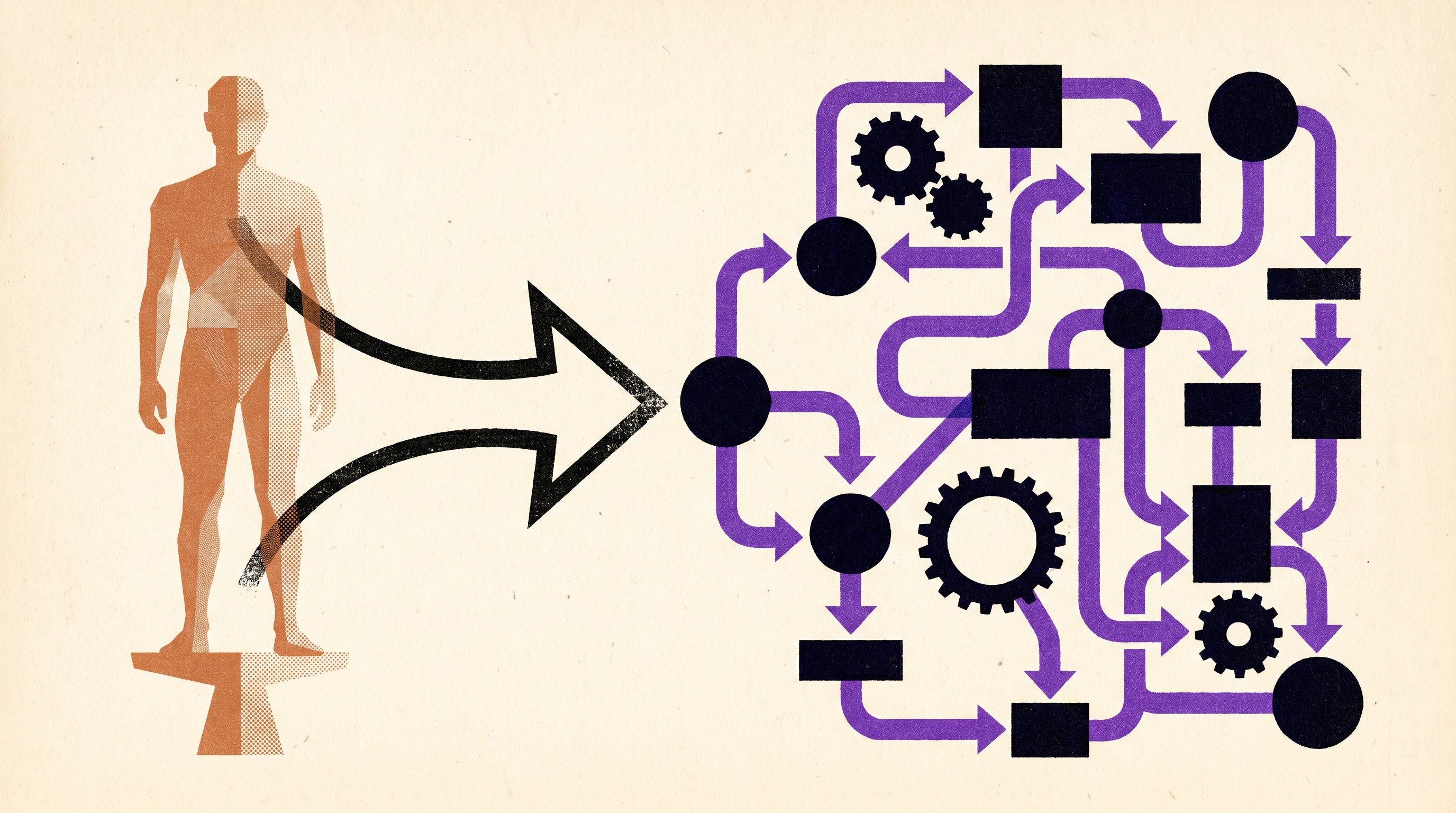
If you were building your organization's AI strategy in 2023 or 2024, there's a good chance you created one. Maybe you called it "AI champion." Maybe "AI lead" or "digital transformation advocate" or "prompt engineering evangelist." The job description varied. The logic was the same everywhere.
Find the person on your team most excited about AI. Train them up. Let them spread the knowledge to colleagues. Watch adoption grow organically.
Two years later, most of those people have moved on, been quietly reassigned, or just stopped trying. The role didn't fail because the people in it were bad at their jobs. It failed because the model itself was broken from the start.
Why did the AI champion model make sense in 2023?
To be fair to 2023 logic: the AI champion role wasn't a bad idea given what the world looked like at the time.
Generative AI had just become accessible to a mainstream business audience. The tools were genuinely novel. Most people in an organization hadn't thought about how to use them in their actual work. The fastest way to close that gap seemed to be identifying the early adopters - people already playing with ChatGPT on weekends - and formalizing their enthusiasm into something the rest of the team could benefit from.
The analogy companies used: safety representatives or data privacy leads. One person per team with specialized knowledge and a mandate to keep colleagues informed. It worked for compliance. Why not AI?
There was also real pressure from the top. Boards and CEOs were asking what their organizations were doing about AI. The AI champion was an answer. A visible one. Something you could point to in an all-hands.
Job boards in 2023 and early 2024 reflected this. "Head of AI Enablement," "AI Adoption Lead," "Prompt Engineering Specialist" proliferated. Typical responsibilities: run internal workshops, build a prompt library, share best practices in Slack, identify automation opportunities, "advocate for AI adoption across the organization."
Compensation was often a lateral move. Budget was usually small or none. The mandate was cultural, not operational.
That gap between mandate and resources is where the model started to fail.
What are the four reasons it failed?
Reason 1: Champions had day jobs
The AI champion role was, in the vast majority of cases, an add-on to an existing position. The person was still a marketing manager, or a sales ops analyst, or an HR business partner. AI advocacy was the 20% on top.
That math doesn't work at any meaningful scale. Researching new tools, running training sessions, maintaining a prompt library, answering colleagues' questions, keeping up with a category that moves fast - this is a full-time job. When it competes with the actual job description, it loses. Every time.
The organizations that made this work long-term were the ones that converted the role into a full-time position with real headcount. That's a small fraction of companies that tried the model.
Reason 2: Champions could teach but couldn't deploy
This is the structural problem that made the others worse. An AI champion could show colleagues how to use a tool. They could not, in most cases, build the actual infrastructure that makes the tool part of how work gets done.
Big difference between "here's how to write a better prompt" and "here's a system that automatically enriches every new lead in our CRM before it hits the sales queue." The first is a skill transfer. The second is a production deployment. Champions were equipped to do the first. Almost none had the technical access, engineering support, or organizational authority for the second.
This meant AI adoption under the champion model tended to produce individuals more productive with AI tools - and organizational workflows that were completely unchanged. The work still happened manually. The agent that could have replaced the manual work was never built.
Reason 3: Nothing got maintained
Even in cases where a champion managed to get something built, there was no system for keeping it running.
AI tools break. Integrations change. Prompts that worked six months ago produce worse results after a model update. The use case that was a good fit for GPT-3.5 might need rethinking for GPT-4o. Maintaining a production AI workflow is a recurring task, not a one-time implementation.
Champions weren't maintenance staff. They didn't have a ticket queue or an SLA. When the prompt library got stale, or the Zapier automation broke, or the recommended tool pivoted its pricing model, there was nobody whose job it was to fix it.
The result: a graveyard of half-working experiments that gradually became liabilities. Teams that started using an AI-assisted workflow and then had it fail were, if anything, more skeptical of AI than before they'd tried.
Reason 4: Nobody measured the outcome
The AI champion model was evaluated on activity, not results. Did the champion run the workshops? Did adoption scores go up in the quarterly pulse survey? Were people "using AI more"?
Very few organizations tracked whether the AI work was actually reducing manual hours, improving output quality, or generating measurable ROI. Two consequences:
- Successful champions couldn't demonstrate impact and struggled to get more resources.
- Failing champions weren't caught early. The model could limp along undetected until the champion left or gave up.
McKinsey's State of AI 2025 data points to measurement as one of the clearest differentiators between organizations that see sustained AI value and those that don't. Companies with dedicated measurement frameworks consistently outperformed the ones running on vibes and workshop attendance.
What did the job actually look like vs. what it became?
Browse archived job postings from 2023-2024 and the pattern is consistent.
Listed responsibilities were ambitious: own AI strategy, drive organizational transformation, build the AI roadmap. Compensation was mid-level individual contributor. Reporting line was often a CHRO or COO who had limited AI expertise and limited time to manage the function.
In practice, the role became a glorified training coordinator. Champions ran lunch-and-learns. They built Notion pages with prompt templates. They answered DMs from colleagues curious about ChatGPT. They tried to get time with engineering to build actual automations and were told there was a backlog.
A number of AI champions from that era have written publicly about the experience. The consistent theme: the gap between what was expected and what was resourced made the role fundamentally unsustainable. One former AI lead at a Series B company described it as "being handed a mandate and a megaphone but no budget and no builders."
By mid-2025, many of these roles had quietly disappeared. Some absorbed into data or engineering teams. Some eliminated. Some of the people in them moved to companies where they could do the actual technical work, rather than advocate for it.
Net result in most organizations: some employees are now better at writing prompts than they were in 2022. The underlying workflows haven't changed.
What's replacing the AI champion model?
The shift underway is from individual advocacy to operational infrastructure. The question isn't "who can evangelize AI?" It's "what tasks can we take out of human hands this quarter, and who is responsible for making that happen and keeping it running?"
This is a meaningfully different model. It doesn't require a culture change before you can start. It doesn't depend on finding the right enthusiast in each department. It runs in production, which means it produces evidence - actual data on hours saved, tasks completed, error rates - that you can use to make the next decision.
The organizations moving fastest in this direction have one thing in common: they've stopped treating AI adoption as an internal capability-building problem and started treating it as an operational delivery problem. The question isn't "how do we get our people to use AI?" The question is "which of our routines should not require a human at all?"
Those are different questions that lead to very different organizational responses. The first produces training programs and champions. The second produces deployed agents running on real workflows.
That's the gap Uplift was built to close. The model is service-led by design: you describe a routine, Uplift's team builds the agent, runs it 24/7, and maintains it as things change. There's no internal champion required because the work doesn't depend on internal enthusiasm. It depends on a team with the expertise to build and maintain production-grade agents, accountable to results.
If you've tried the AI champion model and hit the walls above, the agentic workflows explainer is useful reference for what production-grade AI operations actually looks like. And the AI literacy as a KPI piece is worth reading if your organization is still measuring adoption by training completion rates rather than operational output.
The champion model made sense when AI was a novelty that needed evangelism. That period is over. What organizations need now isn't someone to explain the tools. They need the work to get done.
What's the real lesson from two years of AI champions?
The model assumed the gap between "having access to AI tools" and "AI changing how work gets done" was a knowledge gap. If people knew how to use the tools, they'd use them, and things would change.
The actual gap was an execution gap. Knowing how to use a tool and having a production system running on that tool are two completely different things. You can know exactly how to write a great prompt for lead research and still spend four hours a week doing lead research manually, because nobody built the agent, nobody connected it to your CRM, and nobody is maintaining it.
Closing an execution gap requires execution. That means builders, production authority, maintenance resources, and measurement. It doesn't require a champion.
The organizations that figure this out stop looking for internal evangelists and start asking a different question: who is accountable for this routine running without a human? Once you frame it that way, the AI champion model starts to look like what it was - a plausible-sounding answer to the wrong question.
For a broader look at how this plays out across functions, the hidden cost of low adoption piece is worth reading before your next AI strategy conversation.
Frequently asked questions
Was the AI champion role entirely a waste?
Not entirely. Champions helped surface curiosity about AI inside organizations and broke initial resistance. The waste was assuming that surfacing curiosity would translate to production deployment. It didn't. Champions are reasonable as a temporary awareness function, not as a transformation strategy.
What if we already have an AI champion who's getting results?
Then they're probably either (a) functioning as a part-time engineer, not an evangelist, or (b) running a single high-leverage routine they personally built and maintain. Both work as long as the person stays. The risk is institutional - what happens when they leave or get promoted out of the role?
Who should own AI adoption if not a champion?
An ops-led function with delivery authority, OR a service partner with delivery accountability. Both work. The pattern that fails is anyone with cultural mandate and no production authority. Make sure whoever owns AI adoption has the budget, headcount, or service-partner relationship to actually deploy and maintain.
How do we transition out of a champion model without losing momentum?
Convert the champion's best work into productized routines. Whatever the champion has been doing manually that works - turn that into a maintained agent owned by someone with production responsibility. The champion's role becomes 'point me at the next routine' rather than 'evangelize internally'.
Don't we still need internal AI advocates?
Yes, but informally. Every team needs people who are AI-curious enough to identify routines worth automating. That's a healthy distributed function. What doesn't work is a single named champion with cultural mandate and no operational authority. Distribute the noticing, centralize the deploying.