The phrase "agentic workflows" got everywhere in 2025. Every vendor deck has it. Every AI conference used it in at least three panel titles. Ask ten people in a room to define it precisely and you'll get ten different answers - most technically wrong.
That's a problem if you're responsible for deciding which automation approach your team should actually use. You need to know what you're choosing between, not just what sounds good in a pitch.
This article does the unglamorous work of drawing real lines. What is an agentic workflow, specifically? How is it different from what you already have in Zapier? When does "agentic" make things better - and when does it create a maintenance headache you didn't sign up for?
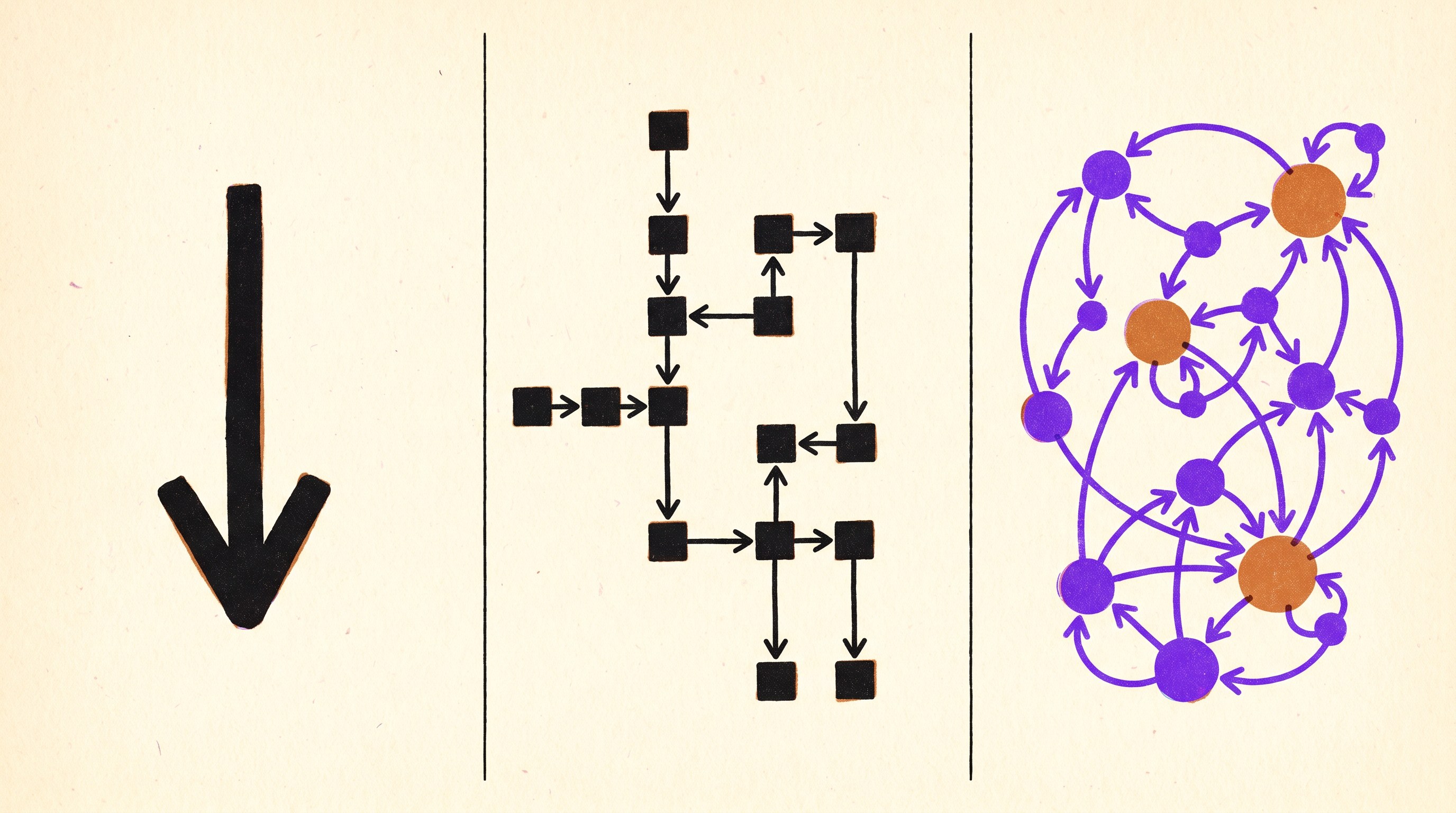
What's the difference between automated and agentic?
Before "agentic" became a marketing word, there was a cleaner set of distinctions. They still matter.
Manual workflows
A human doing the same sequence of steps, repeatedly. An SDR copying lead data from LinkedIn to a CRM. A finance analyst exporting a report, reformatting in Excel, pasting into a slide deck. Nobody calls these "workflows" when they're inside them. They call it Tuesday.
Defining characteristic: a human makes every decision, takes every action, handles every exception. The system does nothing without them.
Automated workflows
Deterministic pipelines triggered by an event - what you get with Zapier, Make, n8n. Something happens (form submitted, deal stage changes, calendar event fires), and a pre-written sequence executes.
Genuinely useful for predictable stuff. If the trigger fires, the data is clean, and the API responds, the workflow completes.
The limitation is what they do when any of those conditions fail. Most deterministic pipelines stop and wait for a human. They weren't designed for ambiguity. They follow the rules you wrote, exactly as you wrote them, and they don't improvise.
For routine, well-defined operations, that's fine. For anything involving judgment or context that changes, they break down fast.
Agentic workflows
Different in one meaningful way: the system has a goal, not just a sequence.
Instead of "do step 1, then step 2, then step 3," an agentic system receives an objective ("qualify this lead and draft a follow-up based on their recent activity") and decides which tools to call, in what order, to reach it. It monitors its own progress. If an API call fails, it retries. If one approach doesn't work, it tries another. If the data is incomplete, it goes fetch more context.
Practical example: a lead arrives in your CRM. A deterministic workflow checks a field and routes it. An agentic workflow looks at the lead's job title, pulls recent LinkedIn activity, checks company funding data, cross-references your account list, writes a personalized outreach draft, then flags for human review if confidence is below a threshold you set. It decides what to do and when to stop.
That's a real capability difference. It's also where the complexity starts.
Why did "agentic" become a fuzzy word?
The honest answer: vendors needed a new word after "AI-powered" stopped meaning anything. "Automated" was too boring. "Intelligent" was too vague. "Agentic" had just enough technical legitimacy to sound credible, just enough ambiguity to stretch over almost anything.
The Stanford AI Index 2026 tracked a sharp increase in agent-related product launches through 2025, with definitions varying widely. Some companies used "agentic" to mean any workflow with an LLM call. Others used it for multi-step reasoning. A few used it correctly - goal-directed systems with tool use and self-monitoring.
The result: "agentic workflows" now means whatever the speaker needs it to mean. Hard to evaluate vendor claims. Hard to scope your own builds. Hard to explain to your CFO why it costs what it costs.
The definition this article uses - goal-directed, tool-using, self-monitoring, capable of retrying and adjusting - is the one that matters for implementation decisions.
What's the maintenance reality nobody warns you about?
Agentic workflows are harder to maintain than deterministic ones. Not a little harder. Significantly harder. If you're evaluating build vs. buy, this cost is almost always underweighted.
Prompt rot
An agentic workflow's behavior depends on natural-language instructions. Those instructions make assumptions about how models interpret things. GPT-4o in January doesn't interpret the same instructions the same way GPT-4o in June does. Models get updated. Behavior shifts.
A prompt that worked reliably for three months starts producing slightly different outputs. Unless you're testing regularly, you won't notice until something breaks downstream.
Not catastrophic. Subtle degradation. Qualification criteria drift. Email tone gets slightly more formal. The "flag for human review" threshold quietly changes.
Model deprecations
Every major LLM provider deprecates model versions on their own schedule. OpenAI, Anthropic, Google - they all give notice, but "notice" is usually 3-6 months and your team has other things going on. When a deprecated model gets cut off, any workflow relying on it stops.
Managing deprecation timelines across multiple workflows - especially when different workflows were built at different times on different model versions - is a legitimate operational burden.
API drift
Your agentic workflow doesn't exist in isolation. It connects to CRM, email platform, Slack, data warehouse. Any vendor can change an endpoint, deprecate a field, alter authentication, add rate limits. Each change can break a workflow that was running fine yesterday.
If you're building this yourself, you own all of it. Every breakage, every model update, every API change lands on your plate.
What pattern actually works in production?
Most production deployments that scale have one thing in common: a deterministic backbone with agentic edges.
The core logic - routing rules, data writes, system-of-record updates, billing triggers - stays deterministic. Business rules that must be predictable and auditable should not be handed to an LLM making judgment calls. Your revenue recognition logic should not depend on how a model interprets an ambiguous edge case today versus next month.
But the edges - unstructured data, natural language, research, summarization, exception handling, context-gathering - that's where agentic capability earns its cost.
A finance ops example
The month-end close process has a deterministic backbone (pull from accounting system, reconcile against bank feed, flag mismatches above $X). The agentic layer handles the flagged mismatches - reviews transaction descriptions, checks vendor records, looks at prior months for similar patterns, drafts a resolution recommendation.
The deterministic part doesn't change. The agentic part does the work that used to take an analyst three hours.
This is the pattern: agentic for judgment, deterministic for rules. Durable automation that doesn't break every time something changes upstream.
When should you NOT go agentic?
This section should probably be longer in most articles about this topic.
When the process is fully deterministic
If every input maps to a known output and there are no judgment calls, a deterministic workflow is faster, cheaper, easier to audit. Adding LLM reasoning to something that doesn't need it adds latency, cost, and failure surface.
When the output affects money or compliance
Anything feeding billing, regulatory reporting, or legal documents should have a human in the loop or be deterministic with clear audit trails. Agentic systems make decisions - that's their value - but also means they can make wrong decisions. In compliance contexts, "the model decided" is not a defense.
When you can't monitor it
An agentic workflow running unmonitored is a liability, not an asset. Prompt rot and API drift don't announce themselves. If you can't commit to regular behavioral testing and alerting, the workflow will degrade silently until it causes a problem.
When the builder will move on
Agentic systems require institutional knowledge. If the person who understood the prompt logic leaves, there's no documentation, and the model gets updated - you have a black box running in production. Happens more than anyone admits.
The hidden workflows problem and the agentic maintenance problem overlap significantly. When automation accretes without ownership, the maintenance cost becomes invisible until it isn't.
How do you decide where agentic fits in your stack?
The decision tree is roughly this:
Is the process fully rule-based with clean data? Use deterministic automation. Don't overcomplicate it.
Does the process involve unstructured inputs, variable context, or judgment-required exception handling? That's where agentic is worth the investment.
Do you have internal bandwidth to monitor, test, and maintain over time? If yes, build. If no, find a partner who does that work for you. The alternative is quietly degrading automation that eventually causes a problem at the worst possible time.
Uplift is built around exactly this gap. Teams describe what they need in plain language, Uplift scopes and builds the agent, then runs and maintains it as prompts drift and APIs change. The maintenance burden - the part that turns "we built something cool" into "we have a problem" - doesn't fall on your team. That's the point of the service layer, and it's why the for-your-team model exists as an alternative to building everything in-house.
Agentic workflows are genuinely powerful. They're also genuinely demanding. The teams that get the most out of them are the ones who understood what they were getting into before they started.
Frequently asked questions
What's the simplest test for whether something should be agentic vs. automated?
Ask: does this require judgment that varies by context, or just rule-following? If a junior analyst would do it the same way every time given the same input, it's automated. If they'd need to think about it each time, it's agentic. Most workflows are a mix - deterministic backbone, agentic edges.
Are agentic workflows just LLM API calls in a loop?
No. An LLM call is a single inference. An agentic workflow uses an LLM to decide what to do next, calls tools (APIs, search, code execution), evaluates the result, and decides whether to continue or stop. The loop, tool use, and self-evaluation are what make it agentic.
What does maintenance look like in practice for a production agentic workflow?
Weekly behavioral testing (does the output still match expectations on a sample set), monthly prompt review against new model versions, quarterly integration testing for API changes, and continuous error monitoring. For a typical agent, expect 2-4 hours of engineering time per month per workflow.
Should small teams build agentic workflows in-house?
Generally no, unless someone is dedicated to it long-term. The build is the cheap part. The maintenance is where small teams quietly fail. Either commit to a permanent owner role or use a service model that absorbs the maintenance burden externally.
Does agentic mean we don't need humans in the loop anymore?
No, and you usually don't want to remove them entirely. The right pattern is humans-on-the-loop, not humans-in-the-loop - the agent runs autonomously, but a person reviews flagged exceptions and audits sample outputs. Full automation with no human oversight tends to fail in ways that get expensive before anyone notices.