Honestly, nobody is wrong for using the two terms as synonyms. Vendors do it, journalists do it, and a good share of the people who build this software do it too. The trouble starts when a buyer takes the difference for a technicality and signs for the wrong one.
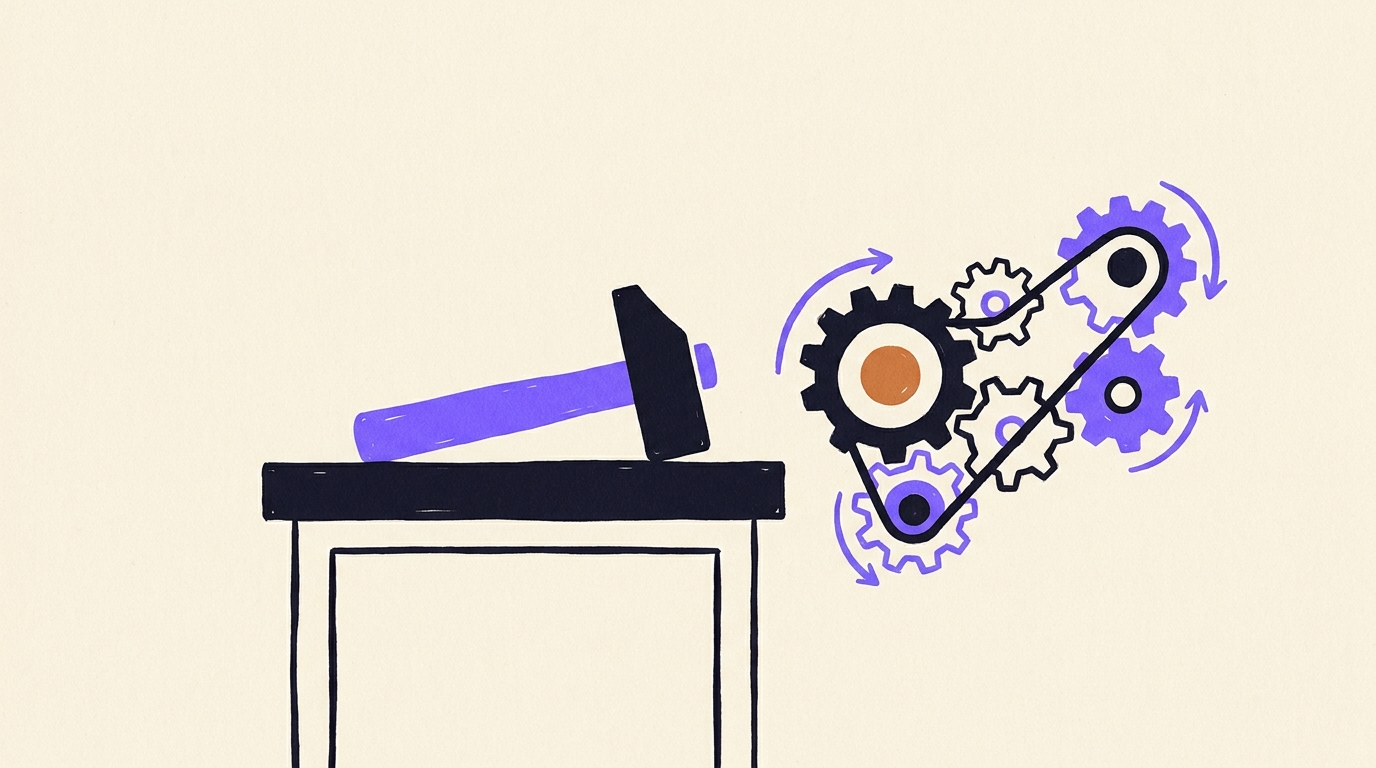
The short version: an AI agent is a single piece that takes a goal and acts on it using tools. Agentic AI is the wider design in which one or more of those pieces are coordinated, given memory and left to decompose a job on their own. One is a part. The other is how the parts are put together.
What is an AI agent?
An AI agent is software built around a language model that is handed a goal, chooses which tools to call, reads what comes back and decides what to do next. It works inside a boundary somebody set: one job, a list of allowed tools, a stopping rule. A support agent that reads a ticket, looks up the order and drafts a reply is the standard example.
Anthropic's engineering team draws the line the same way in its guide to building agents. Workflows are systems where models and tools follow predefined code paths, while agents are systems where the model directs its own process and tool use. The word that matters is "directs". An agent has some room to choose.
What is agentic AI, and how is it different?
Agentic AI is the design layer above single agents: several agents (or one agent running long enough) that split a goal into sub-tasks, hand work to each other, keep memory between steps and adjust the plan as they go. The academic review most often cited on this question, Sapkota, Roumeliotis and Karkee's 2025 paper, frames AI agents as modular and task-specific, and agentic AI as multi-agent collaboration with dynamic task decomposition, persistent memory and orchestrated autonomy.
Two things separate them in practice:
- Scope. An agent answers "do this task." An agentic system answers "reach this outcome," and works out the tasks itself.
- Who holds the plan. With an agent, a person wrote the plan and the model fills in details. In an agentic system, the system writes and rewrites the plan.
| AI agent | Agentic AI | |
|---|---|---|
| What it is | One component | A design of coordinated components |
| Goal given | A task | An outcome |
| Plan written by | A person | The system, revised as it runs |
| Memory | Usually per task | Persists between steps |
| Typical example | Drafting a support reply | Researching a topic across sources |
The paper's own examples make it concrete. Customer support, scheduling and data summarization sit on the agent side. Research automation and robotic coordination sit on the agentic side.
Is the distinction real, or just vocabulary?
It is real, but it is a spectrum, not a border. Nobody has published a standard that says at which point a coordinated set of agents stops being "agents" and becomes "agentic AI," and the paper above is a taxonomy proposed by researchers, not an agreed definition. Treat any vendor who states the boundary with certainty as selling something.
The vocabulary is also being stretched for commercial reasons. Gartner calls the habit "agent washing". Agent washing is relabeling assistants, chatbots and RPA as agentic, such as a rules-based chatbot sold as an autonomous agent. Gartner's June 2025 forecast puts the cancellation rate for agentic projects above 40% by the end of 2027. The same release estimated that only about 130 of the thousands of vendors claiming agentic capability are real, and quoted its analyst saying many so-called agentic use cases do not need an agentic implementation.
The cancellation figure is a prediction, not a count of failures. It rests on a January 2025 poll of 3,412 webinar attendees, which skews toward people already interested in the topic. Read it as a warning about cost and unclear value, not as a measurement.
Why does the gap matter more than the label?
The autonomy gap is the distance between what a system is allowed to decide and what a person checks. The gap matters because every step an agentic system decides for itself is a step that can be wrong in a new way each run. A fixed workflow fails the same way every time, which makes it fixable. A system that rewrites its own plan fails differently on Tuesday than it did on Monday.
Consider what that does to a real routine. The arithmetic is unkind. If each of ten chained steps works 95% of the time, the chain works 0.95 to the power of ten, or 59.9% of the time. For example, a nightly supplier-invoice check with ten chained model decisions would be wrong on roughly four runs in ten. That is a property of chaining, not of any one model, and it is why the more freedom a design gives the model, the more checking the surrounding system needs.
Adoption data shows the same tension. McKinsey's State of AI 2025 reports that 62% of organizations are at least experimenting with agents and 23% are scaling an agentic system somewhere. Yet most of those scaling do so in only one or two functions, and no more than 10% say they are scaling agents in any single function. Interest is wide. Dependable production use is narrow.
Our related pieces cover the two ends of this: how much freedom a production agent is actually given, and why agentic and rule-based automation fail differently.
Which one does your process actually need?
Most business routines need neither a swarm of agents nor free-roaming autonomy. They need a fixed process with a small number of steps where a model reads, classifies or drafts, and code does everything else. That is how Uplift builds: about 95% tested code and 5% AI, with a person describing the routine in plain language and Uplift building, running and maintaining it. You do not operate it or wire it together.
Our own synthesis, not a published standard: three questions, asked in order, with no vendor required.
- Can you write the steps down? For example, "match each invoice to a purchase order." If yes, build a workflow and use a model only for the messy step. That is the cheapest and most predictable option.
- Is the input unpredictable but the output fixed? A single agent with a narrow tool list is enough.
- Is the outcome clear but the path genuinely unknown each time? Only here does an agentic design earn its extra cost, and it should come with a human checkpoint.
Our piece on AI agents versus RPA covers the first rung in more detail.
What does it cost to let someone else run this for you?
A managed model has a plain cost: you do not end up with a codebase, and the automation stops when the plan stops. For a buyer who wants an asset to own at the end, a development shop is the better purchase. What you get in exchange is that the person who built the automation also keeps it running when an app or API changes, and the price is flat, with no tokens or per-seat licenses. If you are weighing that trade, ask any supplier who fixes the automation when a connected system changes, and what happens to it on the day the contract ends.
For a starting list of routines worth automating in your own team, see what we do for your team.
What can't anyone settle yet?
Three questions are still open, and anyone claiming otherwise is guessing. Nobody agrees on where "agent" ends and "agentic" begins. There is no independent benchmark that compares coordinated agent systems on ordinary business routines. And the 40% cancellation figure is a forecast, so the real number will only be known after the fact.
The practical consequence is a simple habit: ask what the system decides on its own, what it is never allowed to decide, and who checks. If the answer to the second question is "nothing," the product is selling autonomy, not results.
Frequently asked questions
What is the main difference between an AI agent and agentic AI?
An AI agent is one goal-driven component that uses tools inside limits somebody set. Agentic AI is the broader design that coordinates one or more agents with memory and the ability to break a goal into sub-tasks and revise the plan.
Is agentic AI the same as an AI agent?
No, though the terms are often used interchangeably. Agent describes a component, while agentic describes how the system behaves. A single agent can be part of an agentic system, but a single agent following a fixed script is not very agentic.
Is ChatGPT an AI agent or agentic AI?
A plain chat reply is neither. It becomes agent-like when the model can call tools and act on your behalf, and agentic when it plans and carries out multi-step work with limited supervision. The same product can behave in all three ways depending on the mode you use.
Do businesses need agentic AI?
Rarely for a routine task. Gartner's analysts say many use cases sold as agentic do not need an agentic build. A fixed workflow with one AI step is cheaper, easier to test and easier to fix when something changes.
Why do agentic AI projects fail?
Gartner names escalating costs, unclear business value and inadequate risk controls. Chained steps also compound errors: ten steps at 95% reliability each give a chain that works about 59.9% of the time.